

Imagine walking into your basement and being greeted by that musty, damp smell that never quite goes away. You’ve tried everything, but the humidity keeps creeping back, leading to mold on walls and a constant feeling of dampness. If this sounds familiar, you need a serious solution, not just a small household unit. This guide is for homeowners and property managers who need a robust, commercial-grade dehumidifier to tackle large, persistent moisture problems in basements, crawl spaces, and other expansive areas. We will explore the top contenders to help you make an informed choice.
When standard dehumidifiers fall short, a commercial model is the answer. These units are built to extract significantly more moisture per day, handle continuous operation, and often come with features like built-in pumps and auto-defrost. In this review, we focus on two powerful options: the Airzentti 155 Pint and the Airecoler 125 Pint. We’ll break down their features, performance capabilities, and ideal use cases so you can pick the perfect fit for your basement. For more insights on tackling basement moisture, you might also find our guide to finished basement dehumidifiers helpful.



Buying Guide: What to Look for in a Commercial Basement Dehumidifier
Choosing the right commercial dehumidifier for your basement goes beyond just picking the highest pint capacity. You need to consider the specific conditions of your space and the unit’s operational features. Here are the key factors we evaluated when selecting our top picks.
Moisture Removal Capacity (Pints per Day)
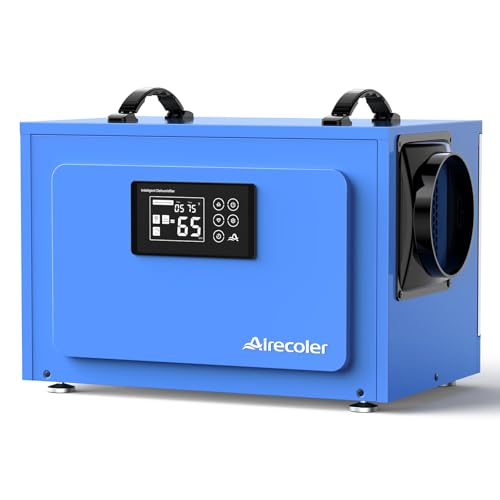
The most critical specification is how much moisture the unit can extract in a day. Commercial dehumidifiers are rated in pints per day, usually under two conditions: at saturation (100% humidity) and at AHAM standard (80°F, 60% humidity). The AHAM rating is more realistic for everyday use. For a large basement, you’ll want a unit that can remove at least 50 pints per day at AHAM conditions. The Airzentti 155 Pint model, for example, removes up to 155 pints per day at saturation and 70 pints at AHAM, making it suitable for spaces up to 7,500 square feet. The Airecoler 125 Pint model removes 125 pints at saturation and 60 pints at AHAM, ideal for slightly smaller areas. Always check the AHAM rating to ensure the unit can handle your basement’s size and humidity level.
Built-in Pump and Drainage Options
A built-in condensate pump is a game-changer for basement dehumidifiers. It allows the unit to pump water upward and out through a window or drain, eliminating the need to manually empty a bucket or rely on gravity drainage. This is especially useful if your basement doesn’t have a floor drain. Both the Airzentti and Airecoler models come with built-in pumps, but their lift heights differ. The Airzentti can pump water up to 16.4 feet vertically, while the Airecoler’s pump lift is not specified but is typically sufficient for most basements. Additionally, look for a gravity drain option with a hose, which provides flexibility in how you set up the unit. The Airzentti includes a 6.56-foot drain hose for gravity drainage, and the Airecoler also comes with a 6.56-foot hose.
Energy Efficiency and Operating Costs
Running a commercial dehumidifier continuously can significantly impact your energy bill. That’s why Energy Star certification is an important feature to look for. Energy Star-rated models are designed to use less electricity while maintaining high performance. The Airzentti 155 Pint is Energy Star certified and TUV compliant, ensuring it operates efficiently. The Airecoler 125 Pint uses an innovative R32 refrigerant system, which is more eco-friendly and energy-efficient than traditional refrigerants. Both models also feature auto-defrost to prevent ice buildup, which can reduce efficiency in colder temperatures. When comparing models, check the energy factor (liters per kilowatt-hour) to see which unit is more efficient. For more tips on choosing an efficient model, you can check our best buy dehumidifier for basement guide.
Durability and Build Quality
Commercial dehumidifiers are an investment, so you want a unit that will last. Look for features like a corrosion-resistant coil, a sturdy cabinet, and a reliable compressor. The Airzentti is built with a metal casing and is designed for industrial environments. The Airecoler has a compact, durable design that can be placed on the floor, on a countertop, or even suspended between floor joists, making it versatile for tight spaces. Both brands offer warranties: Airecoler provides a 5-year covered warranty (2 years for the entire unit, 3 additional years for the dehumidification system), and Airzentti offers a standard warranty. A longer warranty indicates the manufacturer’s confidence in their product’s longevity.
When you’re dealing with a damp basement, you also want a unit that’s easy to maintain. Look for models with washable, reusable air filters that are easy to access. Both the Airzentti and Airecoler have simple filter access, and their auto-defrost and auto-restart features ensure hassle-free operation. If you’re looking for a more budget-friendly option for a smaller space, you might want to read our best dehumidifier for home basement article for more ideas.
Final Thoughts
After a thorough evaluation, both the Airzentti 155 Pint Commercial Dehumidifier and the Airecoler 125 Pints Commercial Dehumidifier stand out as excellent choices for tackling basement moisture, but they cater to slightly different needs. If you have a very large basement or an industrial space exceeding 5,000 square feet, the Airzentti offers the highest capacity and a more powerful pump, making it the ideal choice for extreme moisture control. On the other hand, if you need a compact, energy-efficient unit for a tight crawl space or a standard-sized basement, the Airecoler provides outstanding performance and a longer warranty at a more accessible price point. Whichever you choose, you’ll be investing in a reliable solution that will keep your basement dry and protect your home from mold and mildew damage.
Related Guides
Frequently Asked Questions
What size commercial dehumidifier do I need for my basement?
The size depends on the square footage of your basement and the level of moisture. For a basement up to 2,000 square feet, a unit with a 50-pint capacity (AHAM) is usually sufficient. For larger areas or very damp conditions, you’ll need a unit with 60 to 70 pints (AHAM) or more. Always check the manufacturer’s coverage area recommendation, like the Airzentti’s 7,500 square feet, to ensure it matches your space.
Can a commercial dehumidifier be used in a crawl space?
Yes, absolutely. Many commercial dehumidifiers, including the Airecoler 125 Pint, are designed with a compact build specifically to fit in low-clearance crawl spaces. They can be placed on the ground or even suspended between floor joists. Always ensure the unit has a built-in pump or a gravity drain option to manage water removal in these hard-to-reach areas.
How often do I need to empty a commercial dehumidifier?
With a built-in pump, you rarely need to empty the water tank manually. The pump continuously removes collected water through a drain hose, so you can set it and forget it. If you use the gravity drain option, you’ll need to ensure the hose is positioned correctly for water to flow out. This is a major advantage over portable units that require frequent bucket emptying.
Are commercial dehumidifiers energy-efficient?
Many modern commercial dehumidifiers are Energy Star certified, meaning they meet strict energy efficiency guidelines set by the EPA. The Airzentti 155 Pint is Energy Star certified, and the Airecoler uses a high-efficiency R32 refrigerant. These features help reduce electricity consumption, which is crucial when running the unit for extended periods. For more energy-saving tips, you can read our Frigidaire 50-pint review for comparison.


