

Imagine walking into your basement and being greeted by that familiar, musty smell. You see condensation on the walls, and the air feels heavy and damp. This is a common problem, but it’s one you can solve. The right dehumidifier can transform your basement from a damp, unusable space into a dry, comfortable area. In this guide, we’ve reviewed the top 7 dehumidifiers for home basement use, focusing on capacity, energy efficiency, noise levels, and drainage options. Whether you need a heavy-duty unit for a large basement or a compact model for a smaller space, we have you covered. For more insights, check out our best rated basement dehumidifiers guide.






Buying Guide: How to Choose the Right Basement Dehumidifier
Selecting the perfect dehumidifier involves more than just picking the biggest model. You need to consider your basement’s size, the typical humidity level, and your maintenance preferences. Here are the key factors we weighed when evaluating these products.
Capacity and Coverage Area
The most critical specification is the dehumidifier’s capacity, measured in pints per day. This tells you how much moisture it can remove in 24 hours under specific conditions. For a large basement (over 2,500 sq. ft.), you’ll want a high-capacity unit like the Waykar 80 Pints 5000 Sq. Ft 2025 Energy Star or the AEOCKY 5500 Sq.Ft Energy Star Most Efficient 2025, which can handle up to 5,500 sq. ft. For smaller spaces, a 34-pint or 50-pint model is often sufficient. Always match the unit’s coverage area to your actual square footage for optimal performance.
Remember that capacity is measured at specific temperatures and humidity levels. A unit that removes 80 pints at 95°F and 90% RH will remove less in cooler, less humid conditions. Check the manufacturer’s ratings for typical basement conditions (around 86°F and 80% RH) to get a realistic idea of performance. For a deep dive into capacity needs, see our best buy dehumidifier for basement article.
Energy Efficiency and Operating Costs
Running a dehumidifier 24/7 can add to your energy bills. That’s why we prioritize Energy Star certified models. These units meet strict efficiency guidelines, using less electricity to remove the same amount of moisture. The Waykar 80 Pints 5000 Sq. Ft 2025 Energy Star and the AEOCKY 5500 Sq.Ft Energy Star Most Efficient 2025 are both excellent choices, with the AEOCKY holding the coveted “Most Efficient 2025” title. This designation means it’s in the top 2.6% of all Energy Star models for efficiency, potentially saving you significant money over time.
Look for features like auto-defrost and smart humidity sensors, which prevent the unit from running unnecessarily. A built-in timer also allows you to schedule operation during off-peak hours. If energy savings are your top priority, be sure to read our best brand of dehumidifier for a basement guide for more tips.
Noise Level and Placement
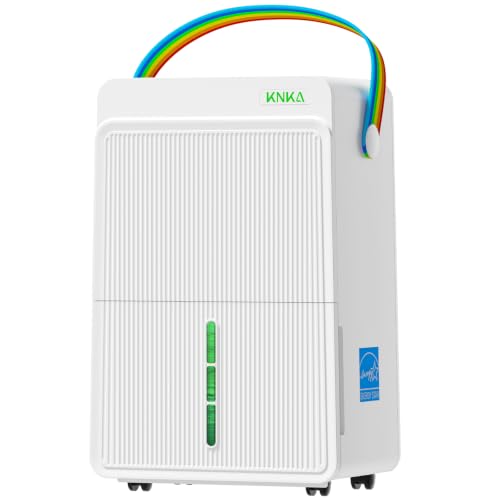
Basements often double as living spaces, home theaters, or bedrooms. A loud dehumidifier can be disruptive. We noted the noise levels of each model, with many ranging from 35 dB to 45 dB, which is comparable to a quiet conversation or a refrigerator hum. The 34 Pint/Day Dehumidifier for Basement with Drain operates at a whisper-quiet 35 dB, making it ideal for bedrooms. For larger spaces, the KNKA Energy Star 5000 Sq.Ft Dehumidifier runs at 40-45 dB, still unobtrusive enough for most living areas.
Placement matters too. Many units come with caster wheels and ergonomic handles, making them easy to move. Some, like the AEOCKY Max 50 Pint/D 3000 Sq.Ft Dehumidifier, are compact enough to fit in tight corners or under low ceilings. Consider where you’ll place the unit and whether you need portable features. For smaller spaces, you might also want to explore our best dehumidifier for basement apartment recommendations.
Drainage Options and Maintenance
You don’t want to constantly empty a water tank. Look for models with a continuous drainage option, which allows you to connect a hose and let the unit drain automatically into a floor drain or sump pump. Most of our picks include a drain hose, and some, like the AEOCKY Max 50 Pint/D 3000 Sq.Ft Dehumidifier, even come with a garden hose adapter for extended drainage paths. If you prefer manual emptying, check the tank capacity. Larger tanks require less frequent attention. Units with washable filters and auto-defrost are also easier to maintain, ensuring long-term reliability.
Consider the ease of cleaning and filter replacement. A washable, reusable filter saves you money in the long run. The KNKA Energy Star 5000 Sq.Ft Dehumidifier features a washable filter and a 1.45-gallon tank, reducing the frequency of emptying. For more tips on maintenance, check out our hisense 50 pint dehumidifier review or frigidaire 50 pint dehumidifier review for similar models.
Final Thoughts
After evaluating these top models, our overall recommendation is the Waykar 80 Pints 5000 Sq. Ft 2025 Energy Star for large basements, thanks to its powerful performance, energy efficiency, and smart features. For those with smaller spaces or a tighter budget, the 34 Pint/Day Dehumidifier for Basement with Drain offers excellent value with its quiet operation and compact design. No matter your choice, you’ll be taking a significant step toward a drier, healthier home.
Related Guides
Frequently Asked Questions
What size dehumidifier do I need for my basement?
For a basement up to 1,000 sq. ft., a 30-40 pint unit is usually sufficient. For 1,500 to 2,500 sq. ft., consider a 50-pint model. If your basement is larger than 2,500 sq. ft., you’ll need a high-capacity unit like the Waykar 80 Pints or AEOCKY 80 Pint, which can cover up to 5,000-5,500 sq. ft. Always measure your space and consider the humidity level, as very damp basements may require a larger unit.
Should I get a dehumidifier with a drain hose or a water tank?
It depends on your preference. A drain hose allows for continuous operation without needing to empty the tank, which is ideal if you have a floor drain. If you prefer portability or don’t have a drain nearby, a large water tank is convenient, but you’ll need to empty it regularly. Many models, like the KNKA, offer both options for flexibility.
Are Energy Star dehumidifiers worth it?
Absolutely. Energy Star certified models use significantly less electricity than non-certified ones, which can save you up to 40% on your energy bills. Over time, the savings can offset the initial cost. Plus, they’re better for the environment. In 2026, look for the “Most Efficient” designation for the top-tier savings.
How often should I clean my basement dehumidifier?
It’s best to clean the filter every two weeks, especially if you run the unit frequently. The water tank should be cleaned monthly to prevent mold and bacteria growth. Also, check the coils and drain hose for any blockages. Regular maintenance ensures your unit operates efficiently and lasts longer. For more tips, see our midea 50 pint dehumidifier review for maintenance advice.


