🔥 Black Friday Dehumidifier Deals 2026: picks worth watching →
Is your home feeling damp and musty, especially in the basement or after a rainstorm? You are not alone. High humidity can lead to mold, mildew, and a general sense of discomfort. That is why finding the best rated dehumidifier for home is essential for creating a healthier, more comfortable living environment. In this guide, we have evaluated the top models on the market in 2026, covering everything from compact units for small bedrooms to powerful machines for large basements, so you can breathe easier and protect your home.
Whether you are dealing with a damp basement, a stuffy bedroom, or a musty garage, the right dehumidifier can make a world of difference. We have reviewed ten top-rated models from leading brands like Waykar, KNKA, and VEAGASO, focusing on performance, energy efficiency, and ease of use. Our goal is to help you find the perfect match for your needs and budget. For more on small-space solutions, check out our guide on the best dehumidifier for a flat.


Buying Guide: How to Choose the Best Rated Dehumidifier for Home
1. Room Size and Capacity (Pints per Day)
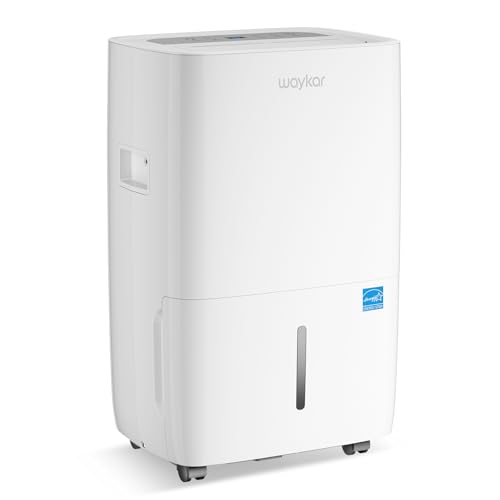
The most critical factor is matching the dehumidifier’s capacity to the size of your space. Capacity is measured in pints of moisture removed per day. A small bedroom or office may only need a 20 to 30 pint model, while a large basement or open-plan living area could require an 80 pint unit. Always check the manufacturer’s recommended square footage, but remember that very damp conditions may need a higher capacity. For larger spaces, consider models like the Waykar 80 Pints 5000 Sq. Ft 2025 Energy Star or the KNKA Energy Star 5500 Sq.Ft Dehumidifier.
Choosing the wrong size can lead to inefficient operation and higher energy bills. An undersized unit will run constantly without ever reaching your desired humidity level, while an oversized one may cycle on and off too frequently. For more tailored advice, see our guide on the best dehumidifier for a large garage.
2. Energy Efficiency and Certifications
Energy efficiency is crucial for long-term savings. Look for units that are ENERGY STAR certified, which means they meet strict efficiency guidelines set by the U.S. Department of Energy. Some models, like the AEOCKY 6000Sq.Ft Commercial Dehumidifier and the Waykar 34 Pints 2025 Most Efficient Energy Star, even achieve the coveted “ENERGY STAR Most Efficient” designation, which represents the top tier of efficiency. These models can save you a significant amount on your electricity bill over time.
Beyond certification, check for features like automatic humidity control and a 24-hour timer, which can further optimize energy use. A unit that automatically shuts off when the desired humidity is reached will use less power than one that runs continuously. For small homes, the best dehumidifier for a small house often combines efficiency with a compact footprint.
3. Drainage Options and Maintenance
Dehumidifiers collect water, and you need a convenient way to dispose of it. Most models offer two options: a removable water tank that you empty manually, or a continuous drain hose that can be routed to a floor drain or sink. For basements or areas where you want unattended operation, continuous drainage is a must. Check the included hose length and whether a standard garden hose fitting is compatible. Also, consider the ease of cleaning the filter and the water tank.
Models like the VEAGASO 34-36 Pint/D, 2500 Sq.Ft Dehumidifier offer both manual and continuous drainage, giving you flexibility. Others, like the KNKA 2500 Ft² Max 34 Pints Dehumidifier, even offer an optional external tank for extended operation. For more on drainage and maintenance, visit our dehumidifiers category page.
Final Thoughts
After evaluating the top contenders, the Waykar 80 Pints 5000 Sq. Ft 2025 Energy Star stands out as the best overall choice for large spaces and basements, thanks to its massive capacity, smart features, and quiet operation. For those on a budget or with a smaller space, the BEDRED Dehumidifier, 95Oz Dehumidifier for Home offers excellent value and a compact design with a helpful auto-shutoff feature. No matter your needs, there is a reliable dehumidifier here to help you reclaim your home from excess moisture.
Related Guides
- Top Dehumidifiers for Attic Spaces in 2026
- 7 Top Dehumidifiers for a 1000 Sq Ft Basement in 2026
- Midea 50 Pint Dehumidifier Review
Frequently Asked Questions
What size dehumidifier do I need for my basement?
For a standard basement (around 1,000-2,000 sq. ft.), a 30-50 pint model is usually sufficient. For larger basements (over 2,000 sq. ft.) or very damp conditions, consider a 70-80 pint unit. Always measure your space and check the manufacturer’s coverage area. For more on basements, see our best dehumidifier for a flat guide, which covers similar principles.
How often do I need to empty the water tank?
This depends on the humidity level and the unit’s capacity. In very humid conditions, a small tank may need emptying every few hours. Larger tanks (over 1 gallon) can last 8-12 hours or more. For convenience, use continuous drainage with a hose if possible. Models with auto-shutoff will turn off when the tank is full, preventing overflow.
Are dehumidifiers noisy?
Noise levels vary by model. Compressor-based units are generally louder than thermoelectric (Peltier) units, but many modern compressor models operate at whisper-quiet levels around 37-42 dB, which is quieter than a conversation. Look for models with a sleep mode or low-speed setting for even quieter operation, especially for bedrooms. The ToLife Dehumidifier, for example, boasts operation below 30 dB in sleep mode.
Can I use a dehumidifier in a cold basement?
Yes, but not all models are suitable. Standard compressor dehumidifiers can struggle below 65°F, as frost can build up on the coils. Look for models with an auto-defrost feature, which automatically melts away frost. The AEOCKY 6000Sq.Ft Commercial Dehumidifier is specifically engineered for cooler environments with its advanced auto-defrost system.