

You come home after a long day, expecting to relax, but a faint musty smell lingers. Or maybe you’re concerned about invisible pollutants from cooking, cleaning products, or outdoor traffic. How do you know if the air you’re breathing is truly safe? That’s where a reliable air quality monitor steps in. This guide reviews the top contenders to help you find the best buy air quality monitor for your needs in 2026.
We’ve evaluated a range of models, from budget-friendly basics to professional-grade devices, focusing on accuracy, ease of use, and smart features. Whether you’re a new parent, a pet owner, or someone with allergies, we’ll help you make an informed choice. For more tailored advice, check out our guide on the best air quality monitor for bedroom use.


Buying Guide: What to Look For in an Air Quality Monitor
Choosing the right air quality monitor can feel overwhelming with so many options. Focus on these key factors to find a device that fits your lifestyle and gives you the data you need.
Sensor Accuracy and Parameters
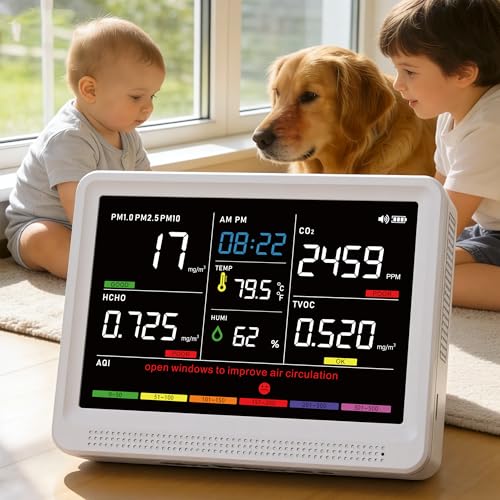
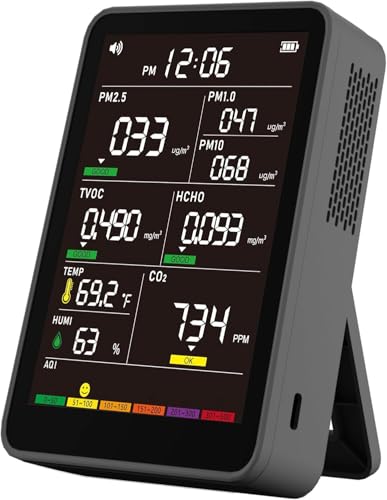
The most critical aspect is what the monitor measures and how precisely it does so. Look for devices that track multiple parameters: PM2.5, PM10, CO2, TVOC, and formaldehyde. A high-precision sensor, such as an NDIR sensor for CO2 or a laser particle counter, ensures reliable data. For example, the Temtop Air Quality Monitor PM2.5 PM10 Particle uses a Dart electrochemical sensor for formaldehyde, which is more accurate than cheaper semiconductor sensors.
Consider what matters most in your environment. If you’re near busy roads, PM2.5 is crucial. If you’ve recently renovated, formaldehyde and TVOC are key. Most monitors offer a combined AQI score, but having individual readings helps you identify specific problems.
Display and Ease of Use
A clear, intuitive display is essential for at-a-glance understanding. Look for a screen with color-coded indicators (green, yellow, red) that quickly show air quality levels. Some models, like the 16 in 1 Air Quality Monitor Indoor High-Precision, feature a large HD display with three brightness levels, making it easy to read in any lighting. Also, consider the button layout: a simple one-tap operation for switching units or muting alarms is a plus.
Portability matters if you plan to move the device between rooms or take it to the office. Check the battery life; some models offer up to 10 hours of cordless use, while others are plug-in only. For a budget-friendly option with a decent display, you might explore cheap ambient air quality monitors.
Smart Features and Connectivity
If you’re building a smart home, connectivity is a game-changer. Wi-Fi-enabled monitors can send real-time alerts to your phone and integrate with voice assistants like Alexa. The Amazon Smart Air Quality Monitor works seamlessly with Alexa, allowing you to create routines that automatically turn on air purifiers when pollution levels rise. Similarly, the GoveeLife Smart Air Quality Monitor with PM2.5 connects with other GoveeHome appliances for automated responses.
Data logging and export are valuable for tracking trends over time. Some monitors offer app-based history for weeks or months, while others allow USB data export for professional analysis. If you’re monitoring after a renovation, this feature is invaluable. For more on how air quality monitors work with purifiers, see our guide on air purifiers for smoke.
Alert System and Alarms
An effective monitor should not only display data but also alert you to dangerous levels. Look for both audible alarms and visual warnings. Many devices feature customizable thresholds for CO2, PM2.5, and other pollutants. A mute button is essential for nighttime use, so you don’t get startled by an alarm when you open a window.
Some advanced models differentiate between alert types (e.g., different sounds for CO2 vs. PM2.5). This helps you quickly identify the issue without looking at the screen. A color-changing LED or screen is a subtle but effective way to communicate risk at a glance.
Final Thoughts
Choosing the right air quality monitor depends on your specific needs, but there’s a clear winner for most households. For a comprehensive, high-precision option, the 16 in 1 Air Quality Monitor Indoor High-Precision offers exceptional value with its 9 parameters and large HD display. If you’re deeply invested in smart home automation, the Amazon Smart Air Quality Monitor is a seamless choice that integrates flawlessly with Alexa. Whichever you choose, you’ll gain peace of mind knowing exactly what’s in the air you breathe.
Related Guides
Frequently Asked Questions
What is the most important parameter to measure in an air quality monitor?
It depends on your environment. PM2.5 is crucial for particulate pollution from smoke, dust, and vehicle emissions. CO2 is a good indicator of ventilation and occupancy. If you have new furniture or paint, monitoring TVOC and formaldehyde is essential. Many monitors offer a combination, so you can track all these factors.
Are expensive air quality monitors worth the extra cost?
Generally, yes, but it depends on the features. Higher-priced models often have more accurate sensors (like NDIR for CO2), a wider range of parameters, and better build quality. They may also offer smart features like Wi-Fi connectivity and data logging. If you need professional-level accuracy or long-term trend analysis, investing more is wise. For basic peace of mind, a budget monitor can still be helpful.
How often should I calibrate my air quality monitor?
Most consumer monitors are factory-calibrated and don’t require manual calibration. However, over time, sensors can drift. Some models offer a self-calibration feature, especially for CO2. It’s a good practice to place the monitor in a well-ventilated area outdoors occasionally to reset baseline readings. Always follow the manufacturer’s instructions for best results.
Can an air quality monitor help with allergies?
Yes, absolutely. By tracking PM2.5 and pollen levels (if the monitor supports it), you can identify when allergen levels are high and take action, such as closing windows or turning on an air purifier. Some monitors integrate with smart plugs to automate this. For more on improving indoor air, check our air quality monitors category.

