
You wake up with a stuffy nose, a scratchy throat, or a dull headache. You blame the weather, but what if the air in your bedroom is the real culprit? From dust mites and pollen to volatile organic compounds (VOCs) off-gassing from your mattress and furniture, your sleep sanctuary could be silently compromising your health. That’s where a dedicated air quality monitor for your bedroom comes in. This guide reviews the top models in 2026 to help you choose the right one for your needs.
We’ve evaluated a range of monitors, from compact and budget-friendly to advanced multi-parameter devices. Whether you suffer from allergies, want to keep an eye on CO2 levels for better sleep, or need to detect hidden mold risks, we’ve got you covered. For a broader look at home monitoring, check out our best air quality monitor for home guide.


Buying Guide: What to Look For in a Bedroom Air Quality Monitor
1. Sensor Coverage: What Pollutants Can It Detect?
Not all monitors are created equal. Some only track PM2.5 (fine particulate matter), while others measure a full suite of pollutants. For a bedroom, you’ll want at least PM2.5, humidity, and temperature. Consider adding CO2, VOCs, and formaldehyde if you have new furniture, paint, or cleaning products nearby. The best indoor air quality monitor for mold often includes humidity and VOCs to catch early warning signs.
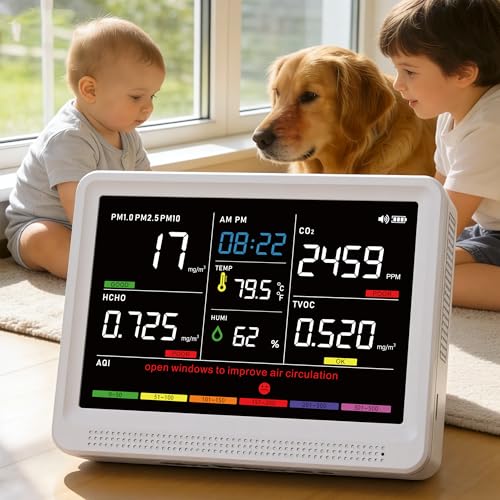
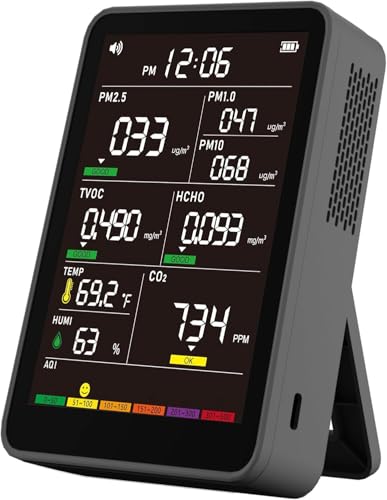
High-precision sensors are crucial for accurate readings. Look for monitors that sample frequently (every 1.5 to 2 seconds) and use laser or NDIR technology for CO2. The AirWhisper 16-in-1, for example, covers PM1.0, PM2.5, PM10, TVOC, HCHO, temperature, and humidity, giving you a complete picture of your bedroom air.
2. Smart Features and Connectivity
Do you want to check your air quality from your phone or get alerts when levels drop? Smart monitors with Wi-Fi or Bluetooth let you monitor remotely, set thresholds for notifications, and even automate other smart devices. For instance, the GoveeLife H5106 can trigger Govee air purifiers or humidifiers to turn on automatically when PM2.5 rises. The Amazon Smart Air Quality Monitor integrates seamlessly with Alexa routines.
If you prefer a simpler, standalone device, a basic monitor with a clear color-coded display might be enough. But for tech-savvy users who want data logging and trends, a connected monitor is worth the investment.
3. Display and Ease of Use
In the middle of the night, you don’t want to squint at a confusing screen. Look for a monitor with a bright, high-definition display that’s easy to read from across the room. Color-coded indicators (green, yellow, red) are helpful for quick glances. Also, consider the controls: a single-button operation or a touch screen can be a blessing when you’re half-asleep.
Some monitors, like the LEVOIT Eleva 300X, have a light sensor that automatically dims the screen in dark rooms, which is perfect for a bedroom. Others have a night mode that turns off the display entirely. Check if the monitor has adjustable audio prompts, as some people find beeping annoying at night.
4. Portability and Power Options
If you plan to move the monitor between rooms, portability matters. Battery-powered monitors offer flexibility, but you’ll need to recharge them regularly. The BREATHE Airmonitor Plus Gen 2 offers up to 6 hours of battery life, while the AirWhisper provides 4-5 hours. Wired monitors, like the GoveeLife H5106, are always ready but less portable.
Consider the charging method: USB-C is becoming standard and convenient. Also, think about the size. A compact monitor won’t clutter your nightstand. If you’re also looking for a device that can help improve air quality, check out our best indoor air purifiers for pet owners guide for combined solutions.
Final Thoughts
Choosing the best air quality monitor for your bedroom comes down to your specific needs and budget. For a comprehensive, high-precision option that covers a wide range of pollutants, the 16-in-1 Indoor Air Quality Monitor is a fantastic choice, offering real-time data and a portable design. If you’re looking for a more affordable, smart monitor that integrates seamlessly into your smart home ecosystem, the Amazon Smart Air Quality Monitor is a solid pick, especially if you’re already invested in Alexa. Whichever you choose, you’ll be taking a proactive step toward healthier sleep and a healthier you.
Related Guides
Frequently Asked Questions
What is the best air quality monitor for a bedroom?
The best air quality monitor for a bedroom depends on your specific needs. For comprehensive coverage, the AirWhisper 16-in-1 is excellent. For smart home integration, the Amazon Smart Air Quality Monitor is a great choice. For a budget-friendly option, the GoveeLife H5106 offers reliable PM2.5 tracking.
How do I know if my bedroom air quality is bad?
Common signs include persistent allergies, headaches, fatigue, or a musty smell. An air quality monitor can provide concrete data on PM2.5, CO2, VOCs, and humidity levels. If levels exceed recommended thresholds, you’ll know it’s time to ventilate or use an air purifier.
Can an air quality monitor detect mold?
Air quality monitors don’t directly detect mold spores, but they can indicate conditions that promote mold growth, such as high humidity and elevated VOCs.
Do I need a CO2 monitor in my bedroom?
CO2 levels can rise significantly in a closed bedroom overnight, leading to drowsiness and poor sleep quality. A CO2 monitor can help you know when to open a window. The BREATHE Airmonitor Plus Gen 2 and the Lwyinp 10-in-1 both include CO2 sensing.